
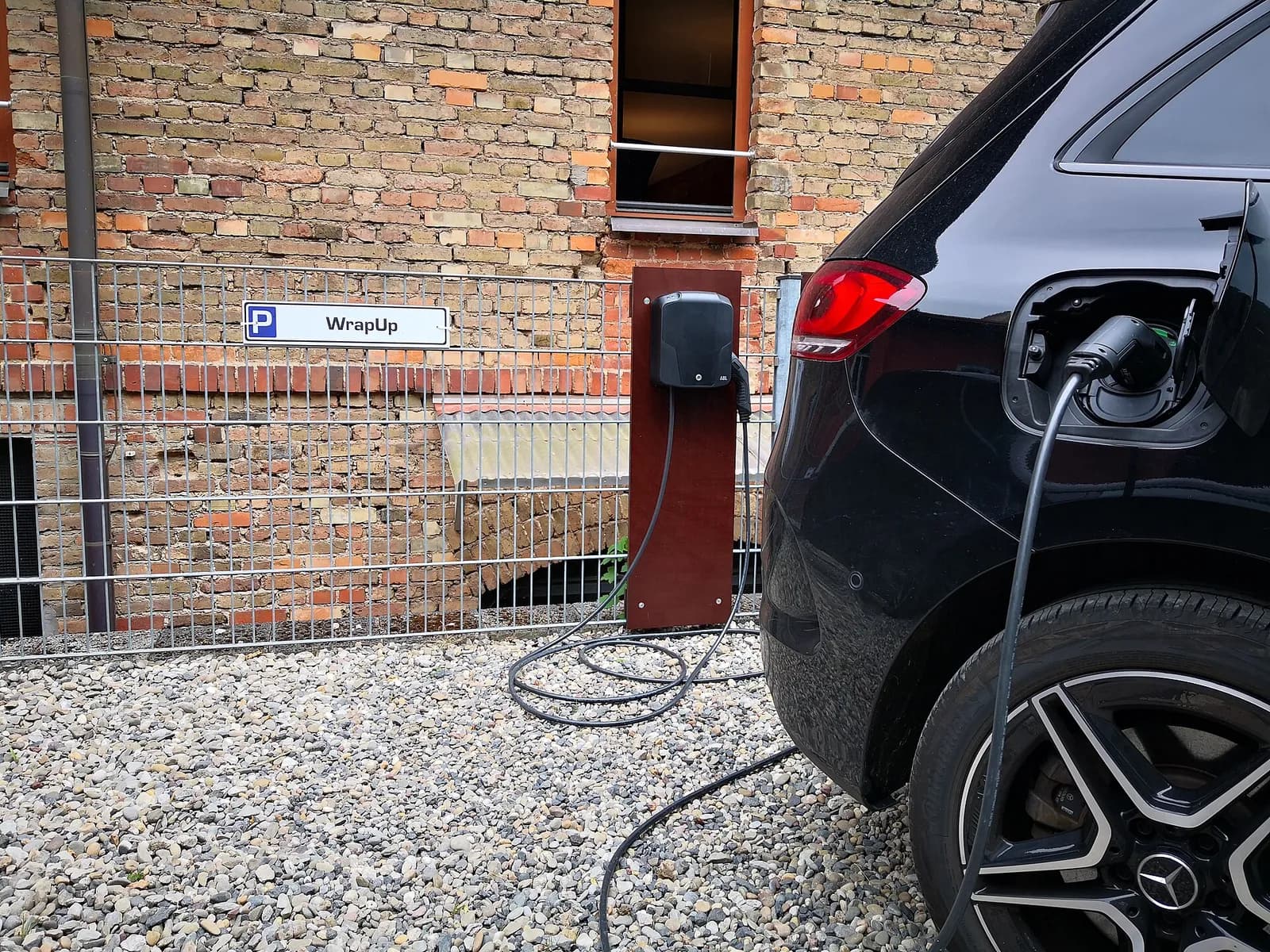
In short: wall socket or EV charger? A standard domestic socket will charge your car, but slowly: around 10 to 13 km of range per hour. That is fine as a back-up or for a plug-in hybrid, but not for everyday use. A wall-mounted charger charges 3 to 5 times faster, on a dedicated, protected circuit, and can manage charging according to the home's consumption.
Wall socket or EV charger: three ways to charge at home
| Solution | Typical power | Range added per hour | Who is it for? |
|---|---|---|---|
| Domestic socket (cable supplied with the car) | Typical power1.8 to 2.3 kW | Range added per hour10 to 13 km | Who is it for?Back-up, plug-in hybrid |
| Single-phase charger | Typical power7.4 kW | Range added per hourabout 40 km | Who is it for?Most homes |
| Three-phase charger | Typical power11 kW | Range added per hourabout 60 km | Who is it for?Three-phase homes, high-mileage drivers |
These figures are orders of magnitude for a car using about 18 kWh per 100 km. The actual speed also depends on the car's on-board charger: a car limited to 7.4 kW will not charge any faster on an 11 kW charger.
Charging from a domestic socket: what you need to know
The cable supplied with the car plugs into an ordinary socket. It has a built-in control box and usually limits the current to 8 or 10 amps to protect the socket.
It is slow
At around 2 kW, a 60 kWh battery needs more than 24 hours for a full charge. If you drive 40 km a day, one night is enough. If you do a long trip at the weekend, the socket will not keep up.
It is not designed for heavy use
An ordinary socket is designed for appliances that run intermittently. A car draws a high current for 10 hours or more, often every night. The contacts of an old or worn socket can then overheat. The risks increase sharply with:
- an extension lead or cable reel: never use one to charge a car;
- a socket on a shared circuit with other large appliances;
- an old installation without suitable RCD protection.
Why an EV charger is safer
A charger is installed on a dedicated circuit, with a cable sized for the power and the distance, and RCD protection suited to charging electric cars. The new circuit is then inspected by an approved inspection body, in line with the RGIE (the Belgian electrical regulations). See our article on the RGIE inspection of an EV charger.
The other advantages of an EV charger
- Speed: one night is always enough, even after a long journey.
- Load management: the charger reduces its power when the house is using a lot, to avoid tripping the circuit breaker. See dynamic load balancing.
- Scheduling: charging at the cheapest times for your region. See when to charge.
- Solar: some chargers give priority to the surplus from your solar panels.
- Monitoring: the app measures the energy used, which is useful for getting company-car charging reimbursed.
- Convenience: with a tethered charger, you just plug the car in. See tethered or untethered charger.
Single-phase or three-phase: which charger for your home?
The power available depends on your grid connection: many Brussels homes are on single-phase or 3 × 230 V, which often limits the charger to 7.4 kW. We explain this in which power to choose and in our article on the 3 × 230 V grid in Brussels.
When a socket may be enough
- You have a plug-in hybrid with a small battery.
- You drive little and the car stays plugged in all night.
- You are waiting for your charger to be installed.
In all other cases, an EV charger is the safest and most convenient investment. To find out the price for your home, answer the questions in the configurator.