
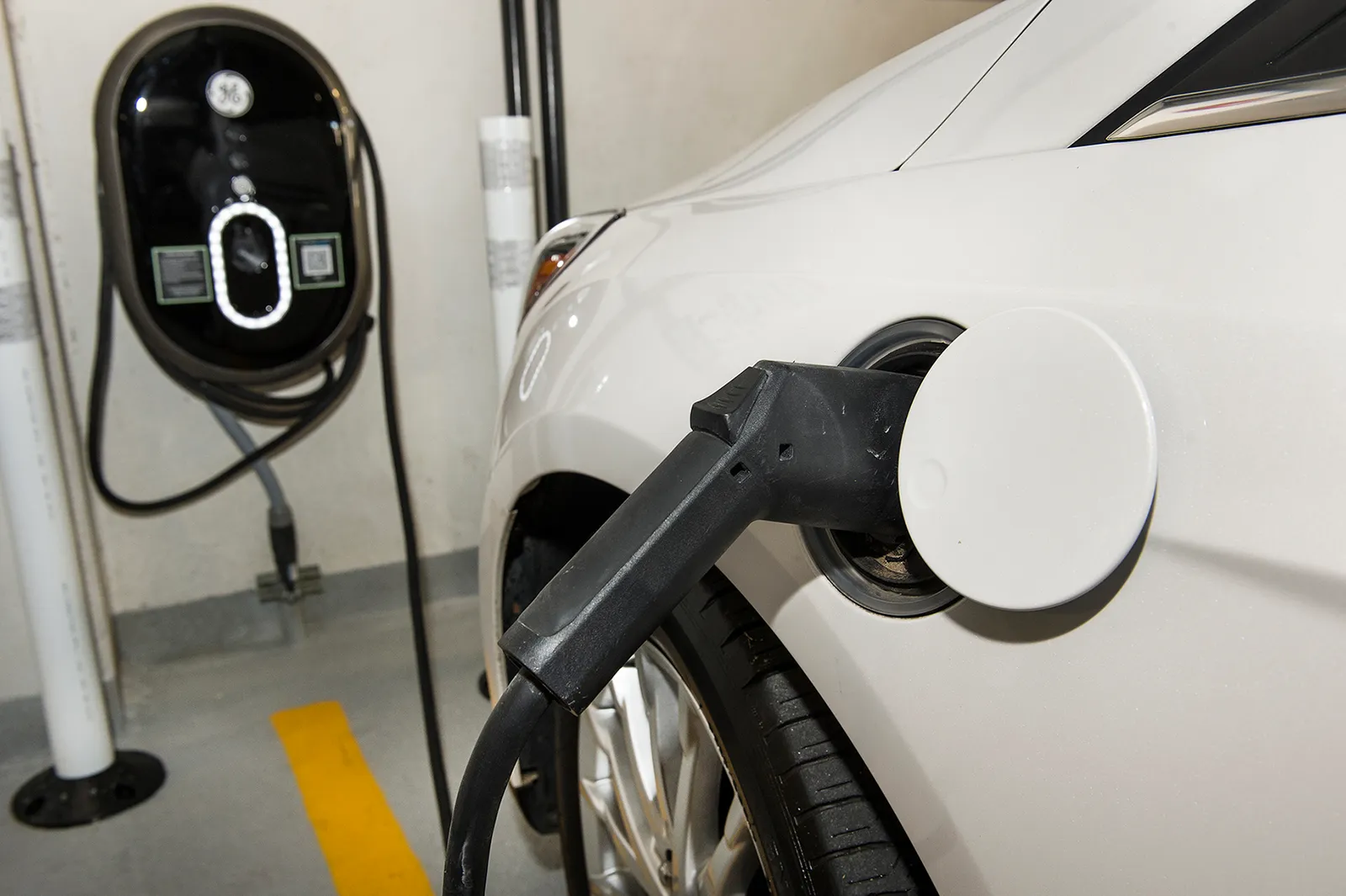
More power means faster charging… provided your car and your home can keep up. Which EV charger power you actually get depends on three factors, and it is always the weakest of the three that sets the limit.
The three factors that set your real charging power
- Your home's grid connection: single-phase, three-phase 3 × 400 V or a 3 × 230 V grid (common in Brussels).
- The charger: its maximum power and how it is configured.
- The car's on-board charger: the maximum power the car accepts on alternating current (AC).
A 22 kW charger on a home with a single-phase supply will never deliver more than 7.4 kW. And a car limited to 11 kW on AC will not charge any faster on a 22 kW charger.
What each power level gives you
| Power | Grid connection required | Range added per hour* | Typical use |
|---|---|---|---|
| 2.3 kW (socket) | Grid connection requiredStandard household socket | Range added per hour*about 12 km | Typical useBack-up, short trips |
| 7.4 kW | Grid connection requiredSingle-phase 32 A | Range added per hour*about 40 km | Typical useFull charge overnight |
| 11 kW | Grid connection requiredThree-phase 3 × 400 V, 16 A | Range added per hour*about 60 km | Typical useLarge batteries, high mileage |
| 22 kW | Grid connection requiredThree-phase 3 × 400 V, 32 A | Range added per hour*about 120 km | Typical useRare: few cars accept it |
*Based on average consumption of about 18 kWh/100 km, excluding charging losses.
7.4 kW: the right choice for most drivers
On average, a car stays parked for many hours overnight. At 7.4 kW, a 60 kWh battery goes from 10 to 80% in just over six hours. For most drivers that is more than enough, and it is the maximum power possible on a single-phase supply.
11 kW: worthwhile if you have three-phase
If your home has a three-phase 3 × 400 V connection and your car accepts 11 kW on AC, an 11 kW charger cuts charging time considerably. It makes sense for large batteries, high-mileage drivers or households with two electric cars.
22 kW: rarely useful at home
Very few cars accept 22 kW on alternating current, and this power level requires a heavy-duty connection. In the vast majority of cases, it brings nothing at home.
What about load balancing?
Whatever power you choose, dynamic load balancing adapts charging to the household's consumption. It often lets you install a more powerful charger without upgrading your grid connection, by reducing the charging power while the oven or the heat pump is running.
How do you know what suits your situation?
Enter your grid connection and your car in our configurator: our expert checks all three factors and recommends the right power. To find out the exact charging time for your model, use our calculator.