
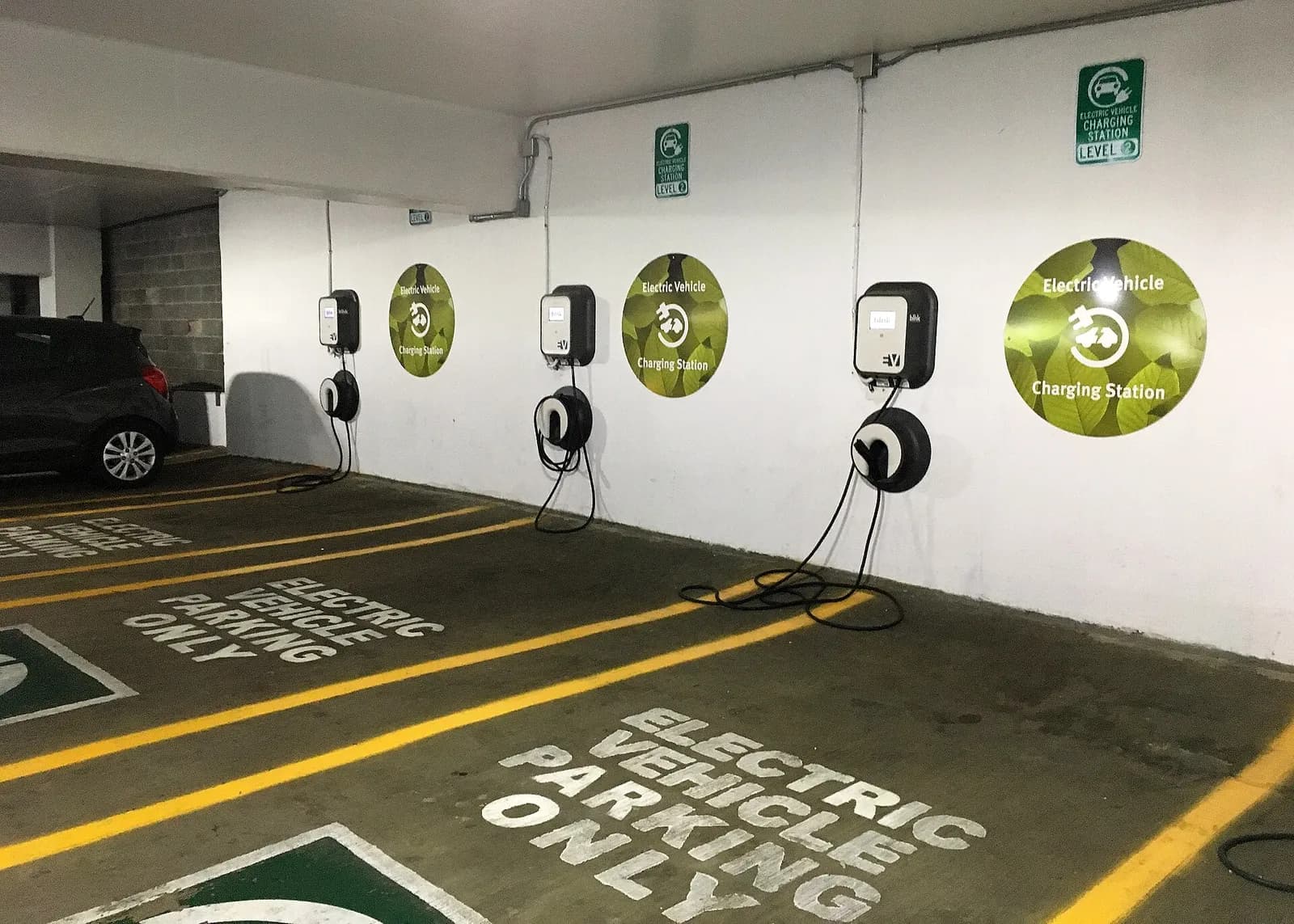
In Brussels, a large share of cars spend the night in the car park of an apartment building. Installing an EV charger in an apartment building is entirely possible, provided you follow the right steps and present a clear proposal to the co-owners' association (ACP/VME).
Step 1: check your situation
Before taking any action, gather:
- the building's co-ownership rules and, if possible, the recent decisions of the general meeting;
- the location of your meter and of your parking space;
- the type of grid connection of the building and of your flat.
This information determines the simplest technical solution.
Step 2: choose between two set-ups
Connection to your own meter
The cable runs from your meter or fuse box to your parking space through the common areas. You pay for your own electricity, with no recharging of costs. For the first co-owner to go electric this is often the simplest solution, if the cable route is feasible.
Shared infrastructure
The co-ownership installs a dedicated supply for the car park, with shared load balancing and metering for each charger. Any co-owner who wishes connects their charger to it, and the electricity is billed back according to the meter reading. This is the most future-proof solution as more electric cars arrive.
Step 3: inform the property manager and prepare for the general meeting
Because the work passes through the common areas, you must inform the property manager (syndic) and, depending on the rules, obtain the approval of the general meeting. A complete proposal makes the decision much easier:
- description of the work and of the cable route;
- safety measures and RGIE compliance inspection;
- how the electricity is metered and billed;
- who bears the costs and the maintenance;
- options for extending the installation to other co-owners.
Step 4: the site survey
In a car park, several points must be checked on site: cable route, available power, ventilation and fire compartmentation, protection of the chargers against impact, and access for the works.
Step 5: installation and inspection
Once approval has been obtained, installation takes from one to a few days depending on the size of the project. The new circuit is inspected by an approved inspection body, then the charger is commissioned and configured.
Questions co-owners often ask
- Who pays? For an individual connection, the co-owner who requests the charger. For shared infrastructure, the split is decided at the general meeting.
- What if others want a charger later? Planning a cable route and a properly sized supply from the outset avoids having to redo the work.
- Does the building have enough power? With dynamic load balancing, several parking spaces can often be equipped without upgrading the grid connection.
To find out more about how we can help, see our page EV charger in an apartment building, or get your price.