
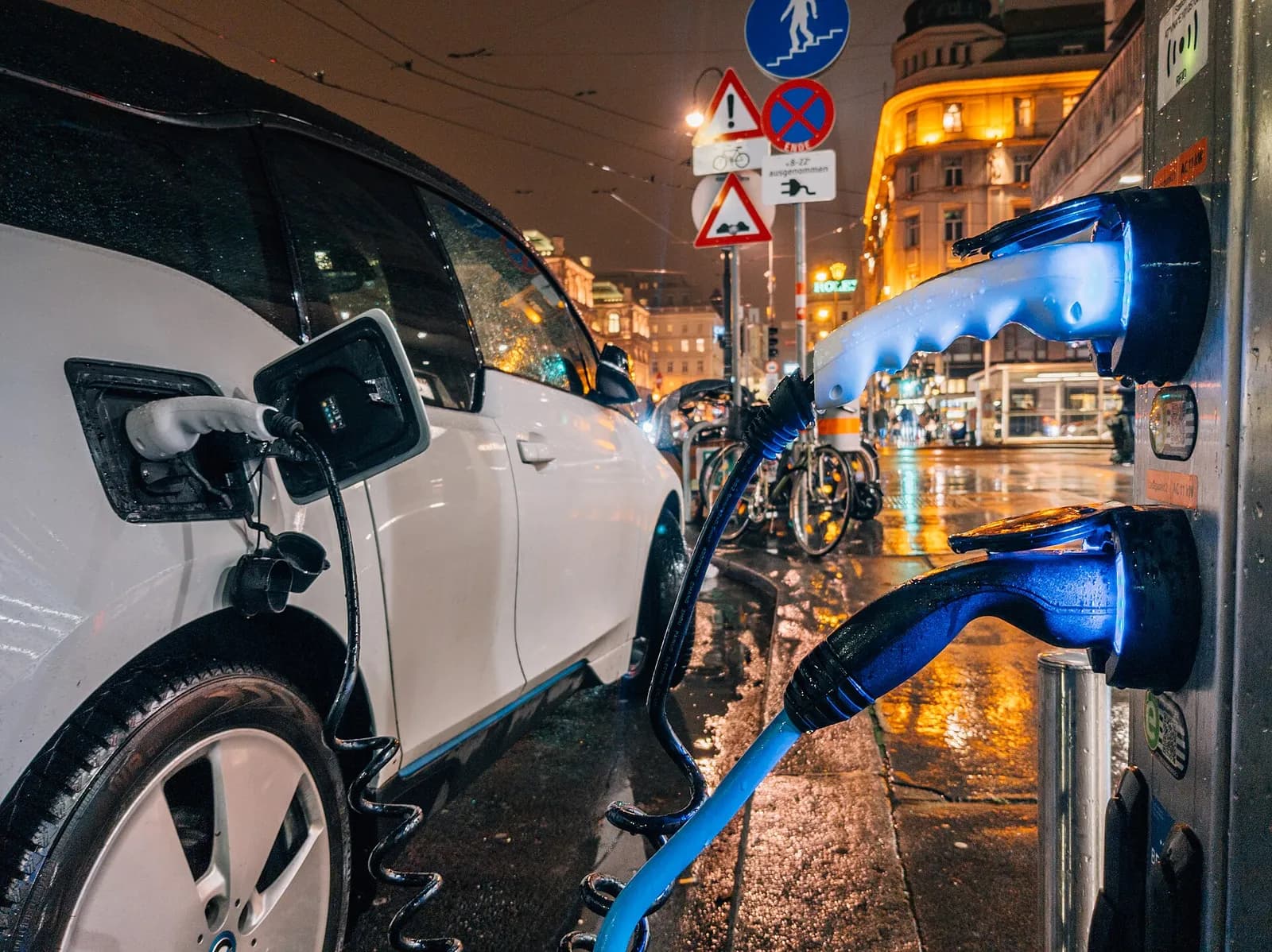
Your EV charging time at home depends on three things: the amount of energy to put back into the battery, the charging power actually available, and the losses during charging.
EV charging time: the simple formula
Charging time (h) ≈ energy to add (kWh) ÷ actual power (kW) ÷ 0.9
The 0.9 factor accounts for roughly 10% of losses when charging on alternating current (AC). The actual power is the lowest of three: that of the charger, that of your grid connection and the power the car can accept.
Examples for a 60 kWh battery, from 10 to 80%
You add 70% of 60 kWh, i.e. 42 kWh:
| Solution | Power | Approximate time |
|---|---|---|
| Domestic socket | Power2.3 kW | Approximate timeabout 20 hours |
| Single-phase charger | Power7.4 kW | Approximate timeabout 6 h 20 min |
| Three-phase charger | Power11 kW | Approximate timeabout 4 h 15 min |
A full charge from 0 to 100% takes proportionally longer, especially as charging slows down when the battery is nearly full.
Why you rarely charge from 0 to 100%
Day to day, you top up what you used the day before. For 50 km a day at 18 kWh/100 km, you need about 9 kWh, i.e. less than two hours on a 7.4 kW charger. Even a full charge fits into one night.
What about winter?
Cold weather increases consumption and can slow charging, especially if the battery has to be warmed up first. Allow a little more time and energy in winter.
Calculate it for your car
Our calculator works out the charging time from 10 → 80% and 0 → 100% for more than 80 car models, with the charger of your choice. To have yours installed: get my price.