
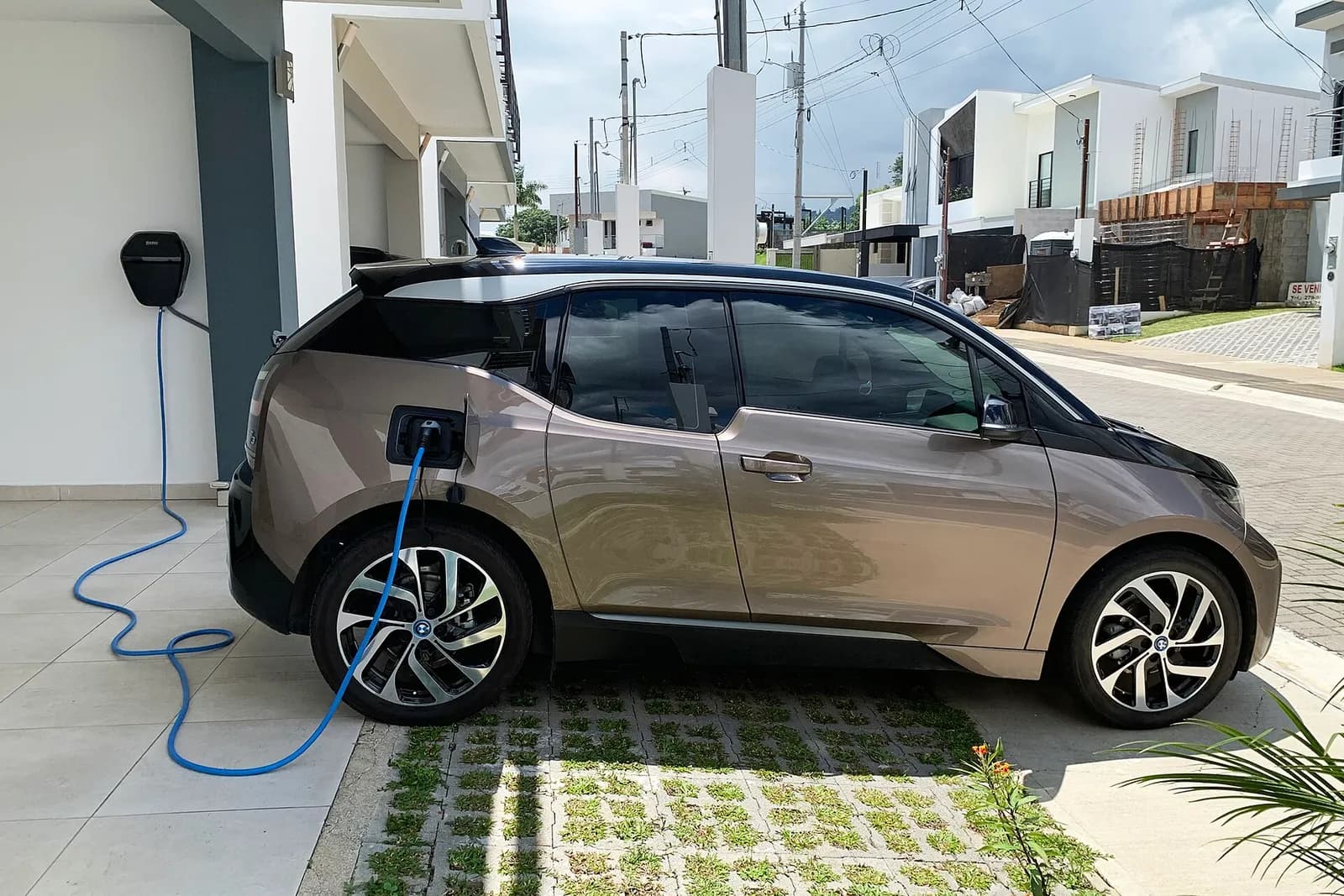
Search online and you will find EV charger prices that vary threefold. The reason is simple: the price of the charger is only part of the bill. The installation depends on your home, and it is the installation that drives most of the EV charger installation cost in Brussels. Here is how to make sense of it.
The two main items: the charger and the installation
A complete quote always includes:
- The charger itself: its price depends on the brand, the power, the cable (tethered or socket) and the smart features (app, load balancing, solar).
- The installation: the dedicated electrical circuit, the protective devices, the fitting, the compliance inspection and commissioning.
Be wary of offers that only show the price of the charger: the installation is where the surprises lie.
What drives the EV charger installation cost?
1. The type of mounting
A wall-mounted charger in a garage, close to the fuse box, is the simplest scenario. A charger on a post along a driveway needs a base and often a trench to bring the cable in.
2. The distance and the cable route
Every metre of cable counts, especially with a large cross-section. The cable can be surface-mounted, run in trunking, recessed into the wall or buried. In Brussels terraced houses, the fuse box is often in the cellar and the garage at the front of the house: the cable route needs careful planning.
3. The condition of the fuse box
There must be room for a new circuit and a suitable RCD. An old or full fuse box may need upgrading or an additional enclosure.
4. Dynamic load balancing
Dynamic load balancing adjusts the charging power to the household's consumption and stops the main circuit breaker from tripping. It often requires a measuring sensor in the fuse box. We recommend it in most cases.
5. The RGIE compliance inspection
The new circuit must be inspected by an approved inspection body (the RGIE inspection is Belgium's electrical safety inspection). Check that this inspection is included in the quote: with us, it is.
VAT: 6% or 21%?
The reduced rate of 6% may apply when the charger is installed in a private home that has been occupied for more than ten years, used mainly as a dwelling, with a certificate signed by the customer. In other cases (recent home, business), VAT is 21%. On a complete installation the difference is significant: check the rate applied in your quote.
Grants and tax benefits
Regional grants and tax benefits for EV chargers change regularly. Before signing, check the current conditions with the official sources (FPS Finance, Brussels Environment) and, for a company car, with your employer, who often covers the cost of the charger.
How do you get a reliable price?
A reliable price means knowing your situation. Our configurator asks you a few simple questions (type of mounting, distance to the fuse box, grid connection) to prepare a quote tailored to your installation. An expert then recommends the right charger and confirms everything, after a site survey if needed.
Pitfalls to avoid
- Paying for power you cannot use: a 22 kW charger brings nothing if your car charges at 11 kW maximum or if your home has a single-phase supply.
- Forgetting load balancing: without it, the main circuit breaker may trip in the evening, when the household is already drawing a lot of power.
- Skipping the RGIE inspection: an uninspected installation causes problems in the event of a claim or when you sell the property.
- Comparing incomplete quotes: check that cabling, protective devices, inspection and commissioning are all included.